OSHA Reporting for Restaurants
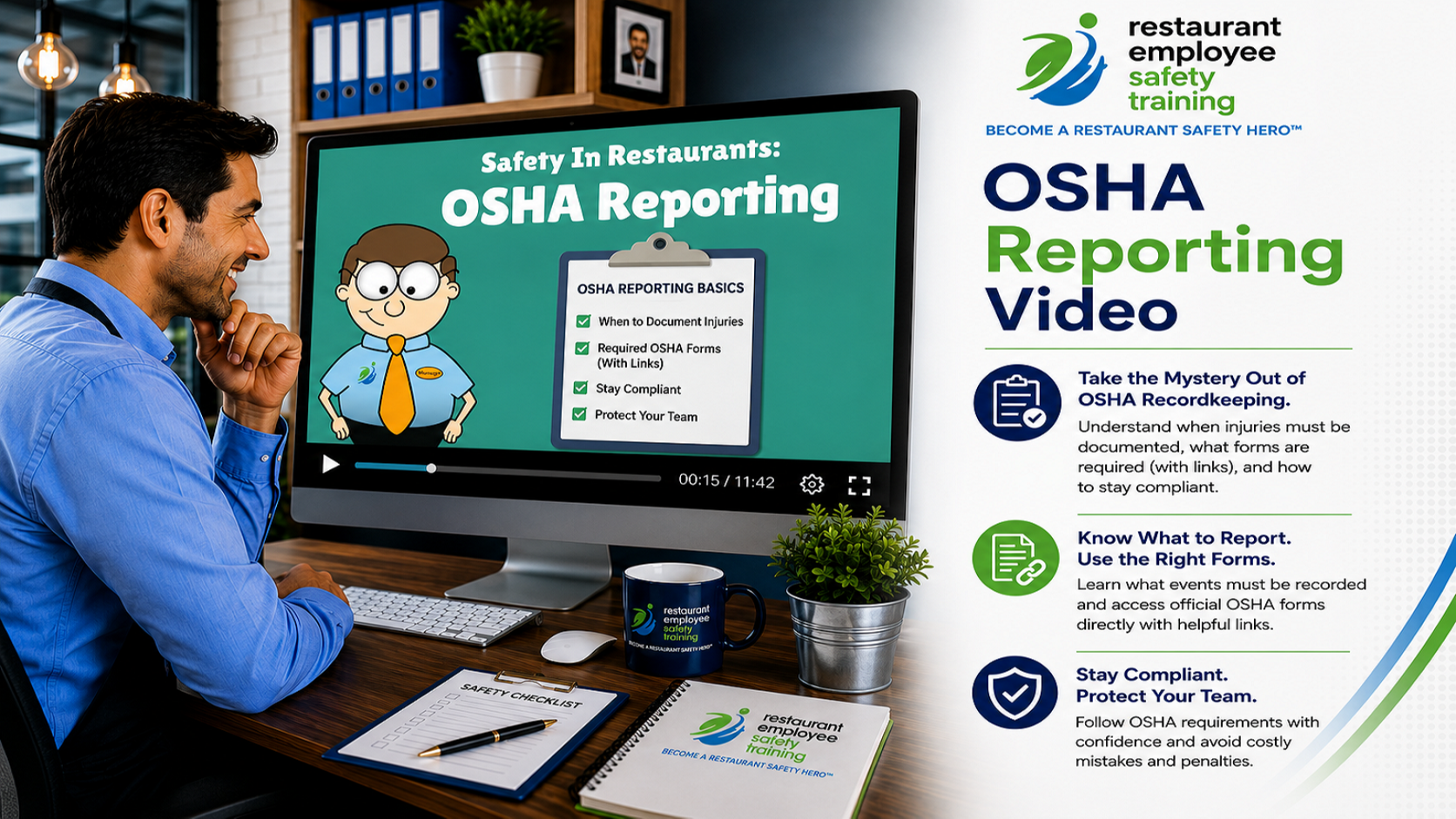
Take the Mystery Out of OSHA Recordkeeping
"OSHA reporting? We're a restaurant. Do we really have to worry about all of that?"
Yes—but exactly what you need to do depends on your restaurant.
That's an important distinction.
As we discussed in our Intro to OSHA Video, restaurants are workplaces, and OSHA workplace-safety requirements don't disappear because your employees work around fryers and dining rooms instead of factories and construction sites.
But OSHA reporting and recordkeeping can be confusing because there are different requirements for different circumstances.
Some restaurants are partially exempt from routinely maintaining OSHA injury and illness records. Others may be required to maintain or submit records based on their circumstances. And all employers covered by OSHA have certain serious-incident reporting responsibilities regardless of routine recordkeeping exemptions.
That's exactly why we created the OSHA Reporting Video.
You don't need to memorize the OSHA regulations.
You do need to understand which questions to ask.
Reporting and Recordkeeping Aren't the Same Thing
This is one of the easiest places to get confused.
OSHA recordkeeping generally refers to maintaining records of qualifying work-related injuries and illnesses using forms such as OSHA Forms 300, 300A and 301.
OSHA reporting includes notifying OSHA when certain serious workplace incidents occur.
Those aren't necessarily the same obligation.
A restaurant may qualify for a partial exemption from routine OSHA injury and illness recordkeeping and still have to report a severe workplace incident to OSHA.
That's worth understanding before an accident happens.
Meet the OSHA 300, 300A and 301
If OSHA recordkeeping requirements apply to your establishment, three form numbers become important.
OSHA Form 300 — Log of Work-Related Injuries and Illnesses
This is the ongoing log used to record qualifying workplace injuries and illnesses.
OSHA Form 301 — Injury and Illness Incident Report
This provides more detailed information about an individual recordable incident.
OSHA Form 300A — Summary of Work-Related Injuries and Illnesses
This summarizes the establishment's recordable injuries and illnesses for the year.
OSHA provides the official forms and instructions directly on its website.
And that's one reason REST provides managers with direct links to the appropriate OSHA resources inside the Restaurant Manager's Safety Command Center™.
You shouldn't have to search the internet wondering whether you've found the current form.
Not Every Cut or Burn Goes on an OSHA 300 Log
This is another important distinction.
Restaurants have minor injuries.
Someone gets a small cut. Someone touches something hot. Someone slips but isn't seriously injured.
OSHA doesn't automatically require every Band-Aid and minor first-aid incident to become a recordable case.
For employers required to keep OSHA injury and illness records, OSHA's general recording criteria include work-related cases involving death, days away from work, restricted work or job transfer, medical treatment beyond first aid, loss of consciousness, or certain significant injuries or illnesses diagnosed by a physician or other licensed health-care professional.
Understanding that distinction helps managers document what they're supposed to document without turning every minor restaurant incident into something it isn't.
Some Restaurants Are Partially Exempt from Routine Recordkeeping
Here's the part that surprises people.
OSHA specifically lists restaurant industries among those that are partially exempt from routine injury and illness recordkeeping requirements.
OSHA has also clarified that changes to restaurant NAICS classifications did not eliminate that partial exemption for full-service and limited-service restaurants.
There are also size-based exemptions. OSHA explains that employers with 10 or fewer employees during the entire previous calendar year generally do not have to routinely maintain these injury and illness records unless OSHA or the Bureau of Labor Statistics tells them otherwise.
But here's the sentence I want restaurant managers to remember:
Partially exempt does not mean OSHA doesn't apply to you.
And it definitely doesn't mean there is nothing you ever have to report.
Some Serious Incidents Must Be Reported by Every Employer
This is where knowing the rules before something happens really matters.
OSHA requires employers under its jurisdiction to report a work-related fatality within 8 hours.
A work-related in-patient hospitalization, amputation, or loss of an eye must generally be reported within 24 hours.
And OSHA specifically says these reporting requirements apply even to employers that are exempt from routinely keeping OSHA injury and illness records because of company size or industry.
Think about what that means in a restaurant.
A severe burn results in an employee being formally admitted to the hospital for treatment.
A slicer or other piece of equipment causes an amputation.
A catastrophic workplace incident results in a fatality.
That's not the moment you want to be asking:
"Wait—are restaurants supposed to report this? Who do I call? How long do I have?"
You want to know where to find the answer.
An Emergency Room Visit Isn't Automatically an In-Patient Hospitalization
Here's another distinction managers should know.
For OSHA's severe-injury reporting requirement, an in-patient hospitalization means a formal admission to the in-patient service of a hospital or clinic for care or treatment.
An employee being treated only in an emergency room does not automatically meet that definition. OSHA also distinguishes hospitalization for care or treatment from hospitalization solely for observation or diagnostic testing.
These details matter.
And they're exactly why managers shouldn't rely on something they vaguely remember hearing years ago.
Know where the current OSHA information is.
If Recordkeeping Applies, There's an Annual Process
For establishments required to maintain OSHA injury and illness records, the responsibility doesn't end when the incident is entered.
At the end of the calendar year, covered employers review their OSHA 300 Log, prepare and certify the OSHA 300A Annual Summary, and post the 300A in the workplace from February 1 through April 30.
Covered employers must also retain the OSHA 300 Log, 300A Summary, 301 Incident Reports and any applicable privacy case list for five years.
Notice something important there:
It's the 300A Summary that's posted.
You don't hang the detailed 300 Log or individual 301 Incident Reports on the employee bulletin board.
Those documents can contain information that doesn't belong on public display.
Electronic Submission Is Another Separate Requirement
And just when you thought we had enough categories...
There's also electronic submission.
Certain establishments must electronically submit injury and illness information to OSHA through its Injury Tracking Application (ITA). Which information must be submitted depends on the establishment's size and industry classification. OSHA provides a coverage tool and current instructions for determining whether an establishment is subject to those electronic submission requirements.
Again, the important lesson isn't:
"Restaurant managers need to memorize all of this."
It's the opposite.
Restaurant managers need a reliable place to find the right information when they need it.
That's Why the Safety Command Center Gives You the Links
This is where the OSHA resources inside the Restaurant Manager's Safety Command Center™ become useful.
We aren't trying to recreate OSHA's website.
OSHA already maintains the official forms, regulations and reporting resources.
Instead, REST helps managers understand what they're looking for, provides step-by-step guidance, and gives them direct access to the appropriate OSHA resources so they're not searching the internet during an already stressful situation.
Need the OSHA recordkeeping forms?
There's a direct path to them.
Need to understand what constitutes a reportable serious incident?
You know where to look.
Need OSHA's reporting resources?
You don't have to start from scratch.
The goal is to remove the guesswork.
NOD™ Would Prefer You Figure This Out Later
The Restaurant Safety Killer™ NOD™—No Ongoing Documentation—would be perfectly happy if you never thought about any of this until after an accident.
Because that's when documentation problems become painfully obvious.
Someone asks what happened.
Was an incident report completed?
Was the employee previously trained?
Is there a training record?
Is there a certificate?
Was the injury recordable?
Was it reportable?
Did anyone make the required report?
Where is the documentation?
That's a terrible time to start designing your system.
The purpose of REST isn't to create more paperwork.
It's to make documentation part of the process before you need it.
Documentation Tells the Story of Your Safety Program
This is where everything we've built into REST starts connecting.
An employee receives safety training.
The employee takes a 10-Question Quiz™ and earns 100%.
An Instant Certificate™ documents successful completion.
The Safety Training Tracker™ records when the training occurred.
The Certificate Tracker™ helps monitor certification status.
Your incident documentation records what happened if something goes wrong.
And your OSHA resources help you determine whether additional recordkeeping or reporting requirements apply.
Individually, those are records.
Together, they tell a story:
This restaurant has an active safety system.
Part Three of the REST Manager Safety Video Series
The OSHA Reporting Video completes the three-part manager safety and compliance series.
Part One — Accident Prevention Program: Understand the pieces that belong in a complete restaurant safety program.
Part Two — Intro to OSHA: Understand OSHA's role and why workplace safety requirements apply to restaurants.
Part Three — OSHA Reporting: Understand the basics of injury reporting, recordkeeping, forms, posting and where to find the official information you need.
You don't need to become an OSHA specialist.
You need enough understanding to recognize when something requires your attention—and a system that helps you know what to do next.
Know What to Report. Know Where to Find It.
OSHA recordkeeping can look intimidating when you're staring at form numbers and federal regulations.
It becomes much more manageable when you understand the structure.
300: the log.
301: the individual incident report.
300A: the annual summary for covered establishments.
8 hours: work-related fatality reporting.
24 hours: qualifying in-patient hospitalization, amputation or loss of an eye.
And perhaps most importantly:
Don't assume that because you're a restaurant, OSHA reporting doesn't apply to you.
Learn the basics now.
Know where the official resources are.
And put a system in place before the day you need it.
The Restaurant Manager's Safety Command Center™ gives managers the training, tools, documentation resources and direct OSHA links they need to make restaurant safety easier to manage—without turning restaurant managers into OSHA experts.
Get instant access to the REST Compliance Protection System™
Trusted by restaurant owners and franchise operators to document safety training and reduce compliance risk.
No contracts • Cancel anytime • Setup in minutes • No IT required.
Have Questions About REST? Let’s Talk Safety.
Whether you’re training 5 employees or 500, we’re here to help you protect your team, document compliance, and save on long-term costs. Fill out the form and we’ll be in touch ASAP.
By submitting this form, you agree to receive safety-related emails from Restaurant Employee Safety Training.
We respect your time and will only contact you with helpful information—no spam, ever.