OSHA for Restaurants
A Simple Introduction to Workplace Safety Requirements
"OSHA? I'm a restaurant. Why do I need to worry about OSHA?"
It's an understandable question.
When many people hear "OSHA," they picture construction sites, manufacturing plants, hard hats, scaffolding, heavy machinery, and industrial workplaces.
They don't necessarily picture the neighborhood restaurant down the street.
But restaurants are workplaces.
And yes, OSHA applies to restaurants.
OSHA covers most private-sector employers and their employees throughout the United States, either directly through Federal OSHA or through an OSHA-approved State Plan. Restaurants aren't somehow outside that system simply because they're serving burgers instead of building skyscrapers.
That's why Intro to OSHA is the second of three manager-focused safety videos in the REST Compliance Protection System™.
You don't need to become an OSHA expert.
But if you're responsible for managing a restaurant and the people who work there, you should understand the basics.
Restaurants Have Real Workplace Hazards
Spend one busy Friday night inside a restaurant and OSHA's involvement starts making a lot more sense.
Employees work around hot cooking surfaces, boiling liquids, fryers, sharp knives, slicers, cleaning chemicals, wet floors, electrical equipment, heavy boxes, flames, crowded workspaces and hurried coworkers.
Those aren't theoretical hazards.
They're part of restaurant life.
OSHA's own restaurant safety resources identify hazards including burns and scalds, slips, trips and falls, strains and sprains, knives and cuts, electrical hazards, fire hazards, workplace violence, heat exposure and equipment hazards.
The goal isn't to make restaurants afraid of those hazards.
It's to recognize them so you can manage them.
What Does OSHA Actually Want from Employers?
At its core, OSHA's mission isn't particularly mysterious.
Employers have a responsibility to provide a safe workplace.
That includes examining workplace conditions, addressing recognized hazards, maintaining safe tools and equipment, establishing appropriate operating procedures, communicating safety requirements, and providing employees with safety training they can understand. OSHA also identifies specific responsibilities in areas such as hazard communication when hazardous chemicals are present.
That sounds a lot less intimidating when you put it in restaurant language.
Know where employees can get hurt.
Teach them how to work safely.
Correct hazards when you find them.
Give employees the information and equipment they need.
And keep the program going.
That's the foundation.
OSHA Doesn't Expect Restaurant Managers to Become Safety Attorneys
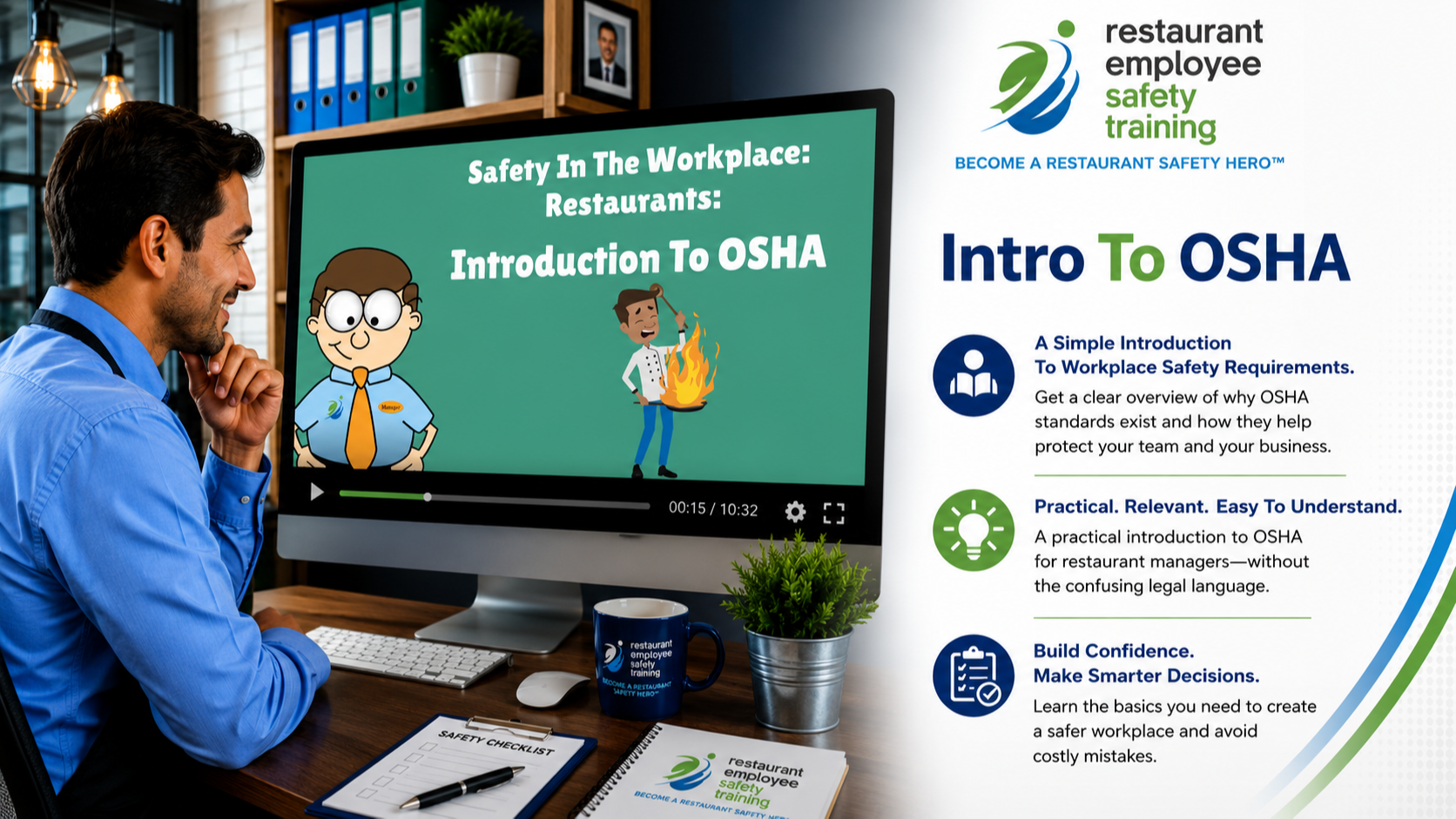
This is one of the reasons we created the Intro to OSHA Video.
Restaurant managers have restaurants to run.
You shouldn't need to spend your evenings reading pages of regulatory language just to understand the basic purpose of workplace safety requirements.
The video gives managers a practical introduction to OSHA: why it exists, what its role is, and why it matters to restaurants.
Once you understand that foundation, the individual requirements start making much more sense.
And you can begin looking at your restaurant through a different lens:
Where could somebody get hurt, and what are we doing to prevent it?
Employee Training Is Part of the Picture
Knowing about a hazard yourself isn't enough.
Your employees need to understand the hazards they encounter and how to work around them safely.
OSHA specifically identifies employee safety training as an employer responsibility and says training should be provided in language and vocabulary workers can understand.
That's particularly important in restaurants because employees may be young, new to the workforce, inexperienced with commercial equipment, or performing a task for the first time.
In fact, OSHA has created restaurant-specific resources specifically for young workers because restaurants are often where young people get their first work experience.
Training shouldn't simply tell someone, "Be careful."
Employees need to know what the hazard is, how to avoid it, and what to do if something goes wrong.
OSHA Can Inspect Restaurants
This is another misconception worth clearing up.
OSHA isn't limited to industrial workplaces.
The OSH Act authorizes workplace inspections and OSHA maintains an enforcement program that includes inspections, citations, and penalties. OSHA's enforcement activities can include responses to worker complaints, fatalities and catastrophes, as well as targeted inspection programs.
That doesn't mean restaurant managers should spend every shift wondering whether OSHA is about to walk through the door.
That's not a useful way to run a safety program.
A much better question is:
If someone did ask about our safety program today, could we show what we're doing?
Could you show that employees receive safety training?
Could you show when that training happened?
Could you show that employees demonstrated understanding?
Could you show your emergency procedures?
Could you locate the documentation you need?
That's where organization becomes valuable.
Don't Wait for an Accident to Think About OSHA
An accident is a terrible time to discover that nobody knows where the safety records are.
It's also a terrible time to realize that an employee was trained once during orientation two years ago and nobody has revisited the subject since.
A safety system works best when it exists before something goes wrong.
That doesn't mean spending hours every week on OSHA paperwork.
It means creating small, repeatable processes that keep safety moving throughout the year.
Training.
Reinforcement.
Documentation.
Emergency planning.
Recordkeeping where required.
A few minutes at a time is much easier than trying to reconstruct everything after an incident.
This Is Where NOD™ Would Love to Meet You
Imagine an employee has a burn injury.
Later, someone asks whether that employee had been trained on burn prevention.
You know they were.
But can you demonstrate it?
That's the opening NOD™—No Ongoing Documentation—is waiting for.
This is why REST doesn't stop with the training video.
Employees complete a 10-Question Quiz™ and earn 100%.
They receive an Instant Certificate™.
The manager records the training and certificate information using the Safety Training Tracker™ and Certificate Tracker™.
Now you've moved from:
"Yes, I'm pretty sure we trained everybody on that."
to:
"Yes. Here's our training record."
That's a much stronger position to be in.
OSHA Is Part of the Bigger Safety Picture
The Intro to OSHA Video isn't intended to stand alone.
It's Part Two of the REST manager safety and compliance video series.
Part One — Accident Prevention Program: Understand the elements that belong in a complete restaurant safety program.
Part Two — Intro to OSHA: Understand OSHA's role and the basic workplace safety responsibilities restaurant managers should know.
Part Three — OSHA Reporting: Understand the reporting and recordkeeping side when workplace injuries and illnesses occur.
Together, the three videos help managers see the bigger picture without turning OSHA into another overwhelming project.
Understanding OSHA Makes the Rest of the System Make Sense
Once you understand what OSHA is trying to accomplish, many of the tools inside the Restaurant Manager's Safety Command Center™ stop looking like separate features.
They start looking like pieces of one system.
Why have ongoing employee safety training?
Because employees need to understand workplace hazards.
Why have quizzes?
Because completion isn't the same thing as understanding.
Why issue certificates and maintain trackers?
Because documentation matters.
Why create emergency plans?
Because employees need to know what to do when something goes wrong.
Why use a Restaurant Safety Calendar™?
Because safety can't be something you remember to do only after an accident.
Everything begins connecting.
Restaurants Never Slow Down. OSHA Responsibilities Don't Disappear.
Restaurant managers don't need another complicated project.
They need to understand what matters and have a manageable way to take care of it.
That's what the Intro to OSHA Video is designed to provide.
A straightforward introduction.
Practical restaurant context.
No expectation that you're going to become an OSHA expert overnight.
Just enough knowledge to understand your responsibilities, make better safety decisions, and recognize where your restaurant may need a stronger system.
Because yes, OSHA applies to restaurants.
But understanding OSHA doesn't have to be frightening or complicated.
Start with the Intro to OSHA Video, then explore the Restaurant Manager's Safety Command Center™ to see how REST helps turn those responsibilities into a safety system busy restaurant managers can actually maintain.
Get instant access to the REST Compliance Protection System™
Trusted by restaurant owners and franchise operators to document safety training and reduce compliance risk.
No contracts • Cancel anytime • Setup in minutes • No IT required.
Have Questions About REST? Let’s Talk Safety.
Whether you’re training 5 employees or 500, we’re here to help you protect your team, document compliance, and save on long-term costs. Fill out the form and we’ll be in touch ASAP.
By submitting this form, you agree to receive safety-related emails from Restaurant Employee Safety Training.
We respect your time and will only contact you with helpful information—no spam, ever.